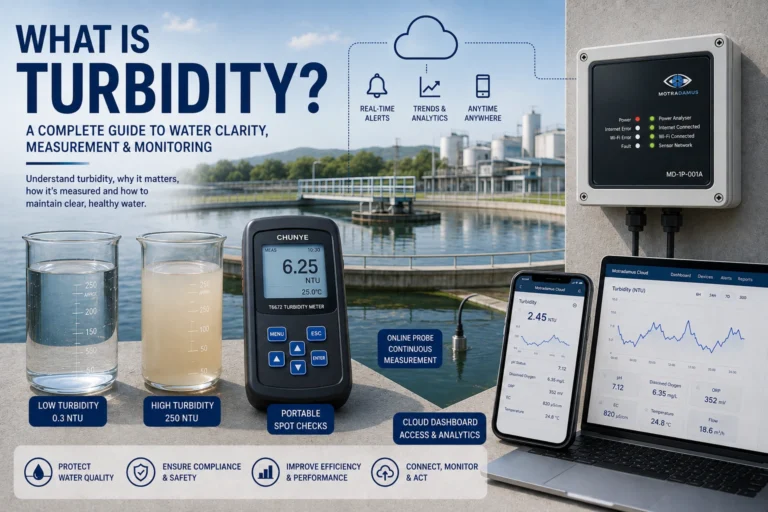
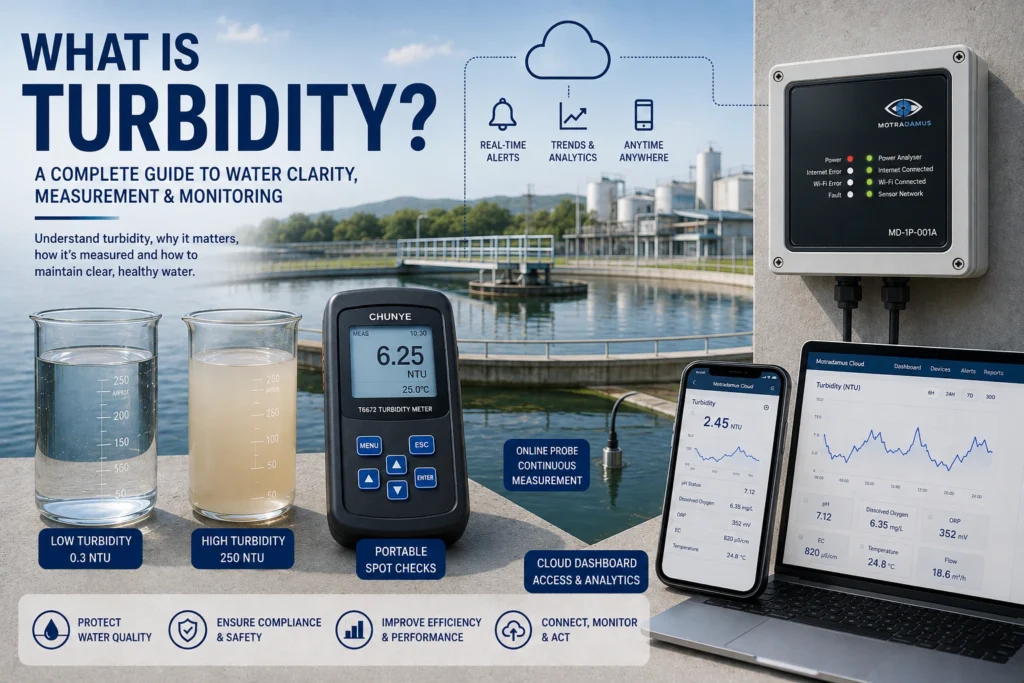
Turbidity is a measure of how cloudy or hazy water appears due to tiny suspended particles that scatter light. These particles may include clay, silt, fine sand, algae, organic matter, bacteria and other microscopic materials.
The clearer the water, the less light is scattered by suspended material. As the concentration of particles increases, more light is scattered and the water becomes increasingly cloudy.
Unlike colour, which may be caused by dissolved substances, cloudiness is generally associated with particles suspended in the water.
Understanding and measuring water clarity is important in drinking water treatment, wastewater, aquaculture, environmental monitoring and many industrial processes. Measurements can be made periodically using portable instruments or continuously using permanently installed sensors.
Why is Turbidity Important?
Turbidity is one of the most widely measured indicators of water quality because changes can provide valuable information about what is happening in a water source or treatment process.
An unexpected increase may indicate soil erosion, stormwater runoff, algal growth, organic pollution, wastewater contamination, industrial discharge or disturbed sediment.
Although suspended particles themselves are not necessarily harmful, an unusual increase can indicate changing conditions that warrant investigation. Cloudy water can also interfere with treatment processes and may provide places for microorganisms to become associated with suspended material.
For this reason, the measurement is often considered alongside other water-quality parameters rather than in isolation.
What Makes Water Cloudy?
Suspended material can enter water from both natural processes and human activity.
Natural causes include heavy rainfall, flooding, riverbank erosion, wind disturbing lake or reservoir sediments, algal blooms and decaying vegetation.
Human activities can also have a significant effect. Construction, agriculture, mining, dredging, wastewater discharge and some industrial processes can introduce suspended material into waterways.
The cause is important because the same visual appearance can result from very different circumstances.
Why Cloudy Water Can Be a Problem
The significance of suspended material depends heavily on the application.
Drinking water: Cloudy water is aesthetically undesirable and suspended material can interfere with treatment and disinfection processes.
Aquaculture: High levels of suspended solids can affect fish gills, feeding and the aquatic environment. Water clarity may therefore be monitored alongside dissolved oxygen, temperature and pH.
Rivers and lakes: Suspended particles reduce the amount of sunlight penetrating the water. This can affect photosynthesis by aquatic plants and influence the wider ecosystem.
Wastewater treatment: Changes in clarity can provide useful information about treatment performance, settling and filtration.
Industrial processes: Food production, manufacturing and other industries may monitor water clarity as part of process control or quality assurance.
How is Turbidity Measured?
Modern turbidity meters use an optical measurement technique.
A light source directs light into a water sample. Suspended particles scatter some of that light rather than allowing it to travel directly through the sample.
In a nephelometric instrument, a detector measures light scattered by the sample, commonly at an angle of 90 degrees to the incident light beam.
The amount of scattered light is then converted into a numerical measurement.
This technique is known as nephelometry and is widely used in portable, laboratory and online water-quality instruments.
What Does NTU Mean?
Most portable meters express results in NTU, which stands for Nephelometric Turbidity Units.
In simple terms, a low NTU reading indicates relatively clear water, while a higher value indicates greater light scattering from suspended material.
There is no single NTU value that defines “good water” for every application. The significance of a reading depends on the water source, its intended use and any applicable water-quality or regulatory requirements.
A value that is normal for a river after rainfall, for example, could represent a significant change in a treated water process.
This is why the measurement should always be interpreted in context.
What Can an NTU Reading Tell You?
A single reading provides a snapshot of conditions at the time of measurement. A series of readings can reveal considerably more.
For example, a sudden increase in an otherwise stable water supply could indicate sediment disturbance, runoff following rainfall, a filtration problem or a change elsewhere in a treatment process.
A gradual change can be equally important.
If a process normally produces very consistent readings and they begin slowly increasing, the trend may provide an early indication that something is changing before the water becomes visibly cloudy.
Establishing a normal operating range can therefore make unusual conditions easier to identify.
What is an Acceptable NTU Reading?
There is no universal value applicable to every type of water.
For drinking water, treatment requirements and applicable standards should be consulted rather than relying solely on a generic number. Water treatment processes commonly aim for very low readings because clarity can affect the effectiveness of subsequent treatment and disinfection.
Environmental water is much more variable. Rivers, lakes, dams and ponds can change significantly following rainfall, erosion, algal activity or disturbance of bottom sediments.
Industrial and wastewater applications can operate across a much wider measurement range.
The important question is therefore not simply “What is a good NTU?” but:
“What reading is appropriate for this water source and this application?”
Turbidity vs Total Dissolved Solids (TDS)
These measurements are frequently confused, but they describe different characteristics of water.
Turbidity measures the effect of suspended particles on the passage and scattering of light.
Total Dissolved Solids (TDS) relates to substances dissolved in the water, such as minerals and salts.
Consequently, water can be visually crystal clear while having relatively high TDS. Conversely, water containing fine suspended clay could appear cloudy without necessarily having a particularly high dissolved-solids concentration.
A water-quality assessment may therefore include both measurements.
Cloudiness vs Water Colour
Colour and cloudiness are also different characteristics.
Water can appear coloured because of dissolved substances such as tannins. It can also appear brown because of suspended clay or other particles.
An optical clarity measurement responds primarily to suspended material scattering light, whereas water-colour measurements assess colouring substances.
This distinction can be important when investigating why a water sample looks different from normal.
Clear Water Can Still Have Water-Quality Problems
Visual inspection is useful, but water should not be assumed to be suitable simply because it looks clear.
Dissolved minerals and salts may be present without creating visible cloudiness. Changes in pH, conductivity, dissolved oxygen and oxidation reduction potential (ORP) may also occur without producing an obvious visual change.
Similarly, some contaminants cannot be detected by appearance alone.
Water clarity should therefore be considered as one component of a broader water-quality assessment.
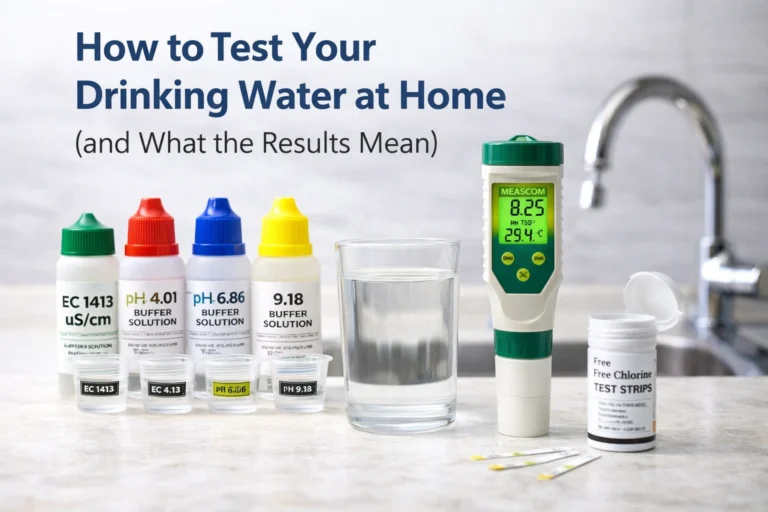
Depending on the application, other useful measurements can include pH, electrical conductivity, TDS, dissolved oxygen, ORP and temperature.
How Can Water Clarity Be Improved?
The appropriate treatment depends on the cause of the suspended material and the intended use of the water.
Common treatment methods include sedimentation, coagulation, flocculation, filtration, membrane filtration, cartridge filtration and slow sand filtration.
In a treatment process, measurement before and after a filtration stage can also help determine how effectively suspended material is being removed.
When readings unexpectedly deteriorate, investigating the cause is generally more useful than simply treating the symptom.
Portable Spot Checks or Continuous Measurement?
Portable turbidity meters are well suited to applications where measurements are required periodically or at multiple locations.
An operator can collect a sample, perform a measurement and record the result as part of a routine inspection or water-quality program.
This approach is particularly useful for field work, laboratories, environmental surveys, troubleshooting and verification.
Continuous measurement serves a different purpose.
An installed sensor can take measurements automatically throughout the day and night. This allows changing conditions to be detected between manual inspections and can provide a much more detailed picture of what is happening over time.
The two approaches are therefore complementary.
Portable instruments provide flexibility for spot checks. Continuous sensors provide ongoing visibility.
In many applications, using both provides the most useful information.
Why Trending Water Quality Matters
A measurement becomes considerably more useful when it can be compared with previous measurements.
Consider a process that normally produces very stable readings. A gradual upward trend may be significant even though the absolute value has not yet reached an alarm or regulatory threshold.
Historical trends can help identify:
- gradual deterioration in filtration performance;
- changes following rainfall or runoff;
- sediment disturbance;
- recurring variations at particular times;
- changes associated with production processes; and
- whether corrective action has actually improved conditions.
Trend records can also make it easier to investigate an event after it has occurred.
Continuous Water Quality Monitoring
Applications where conditions can change quickly may benefit from permanently installed sensors.
Examples include drinking water treatment, aquaculture, wastewater treatment, environmental monitoring, mining, food manufacturing and industrial water systems.
A continuous monitoring system can collect readings automatically and build a historical record rather than relying solely on occasional manual measurements.
When connected to a suitable monitoring platform, abnormal readings can also trigger alerts so that operators can investigate promptly.
This is particularly valuable at remote or unattended sites where a problem could otherwise continue for many hours before somebody performs the next inspection.
Measuring Multiple Water Quality Parameters
A major advantage of connected monitoring is the ability to examine several measurements together.
Depending on the application, these could include:
- pH
- electrical conductivity (EC)
- total dissolved solids (TDS)
- dissolved oxygen (DO)
- oxidation reduction potential (ORP)
- temperature
- flow
- water level
- water clarity
The relationship between parameters can sometimes provide more information than any individual measurement.
For example, an aquaculture operator may want to examine dissolved oxygen, temperature and pH alongside changing water clarity. A treatment process might instead concentrate on pH, conductivity, ORP and filtration performance.
This creates a much more complete picture of changing water conditions.
From Measurement to Cloud Monitoring
Modern sensor technology makes it possible to move beyond simply displaying a measurement locally.
An installed sensor can provide information to a controller or gateway, which can then transmit measurements to a cloud-based monitoring platform.
Authorised users can potentially view current readings and historical trends from a computer, tablet or smartphone without needing to be physically present at the site.
Depending on the monitoring system, alerts can also be generated when readings move outside user-defined limits.
This approach can be particularly valuable for remote installations, water treatment facilities, aquaculture, unattended equipment and industrial applications.
It does not eliminate the need for portable instruments. Handheld meters remain valuable for commissioning, verification, troubleshooting and measurements at locations where permanent instrumentation is unnecessary.
Choosing a Turbidity Meter
The right instrument depends primarily on how and where it will be used.
Important considerations include measurement range, accuracy, resolution, calibration requirements, portability, environmental protection, data logging and the frequency with which measurements are required.
For occasional testing at different locations, a portable meter may be the simplest solution.
For a laboratory, repeatability and sample handling may be more important.
For a process where conditions can change rapidly, an installed sensor with data logging, remote access and alarm capability may provide significantly greater value.
The starting point should therefore be the application rather than simply comparing instrument specifications.
Frequently Asked Questions
Is turbidity the same as TDS?
No. One relates primarily to suspended particles scattering light, while TDS relates to substances dissolved in water.
Can clear water still have poor quality?
Yes. Many dissolved substances and microorganisms cannot be identified simply by looking at water. Visual clarity is only one indicator of water quality.
Does boiling remove suspended particles?
Boiling is primarily a disinfection process. It does not provide a substitute for filtration where suspended material needs to be removed.
Why can readings change after heavy rain?
Rainfall can carry soil, organic material and other particles into rivers, dams and other water sources. Increased flow can also disturb existing sediments.
Should I use a portable meter or an online sensor?
That depends on the application. Portable instruments are ideal for spot measurements and testing multiple locations. Online sensors are more appropriate when continuous records, trends or rapid notification of changing conditions are required.
How often should water clarity be measured?
The appropriate frequency depends on how quickly conditions can change and the consequences of missing an abnormal condition. Some applications may only require periodic measurements, while treatment processes or remote installations may benefit from continuous monitoring.
Professional Water Quality Measurement and Monitoring
Meascom supplies water-quality instrumentation for environmental monitoring, drinking water, wastewater, aquaculture, hydroponics and industrial applications.
Portable instruments provide a practical solution for spot measurements, verification and field testing, while permanently installed sensors can provide continuous measurements where conditions need to be observed over time.
As water-quality management becomes increasingly connected, cloud monitoring can add historical trends, remote visibility and automated alerts to traditional measurement.
This allows organisations to move from simply taking a measurement to monitoring change, identifying problems and taking action.