If your fish are showing abnormal behaviour or dying suddenly, immediate action is critical. In most cases, fish losses are caused by rapid changes in water quality — not disease — and conditions can worsen within hours. The good news is that in many situations, further losses can be reduced if you act quickly and identify the cause.
🧪 Immediate 4 Steps
| Step | Action | Why It Matters |
|---|---|---|
| 1 | Order Detox and Ammonia Test Kit (express delivery) | Crucial step to arresting fish deaths |
| 2 | Stop feeding immediately | Prevents further ammonia buildup |
| 3 | Increase aeration or water movement | Improves oxygen levels and reduces stress |
| 4 | Perform a partial water change (10–30%) | Dilutes ammonia and improves water quality |
| 5 | Test water and determine the concentration of Ammonia | Determone the level of the problem |
| 6 | Calculate and then add the required amount of Seachem Prime to the water | See instrucxtions on SeaChem Prime fast acting Ammonia neutraliser |
👉 While the test kit is on the way, steps 2, 3 anmd 4 help stabilise conditions and prevent further losses.
⚠️ Important: Ammonia Is Often Only Part of the Problem
While ammonia is a common cause of fish deaths, it is rarely the only factor involved.
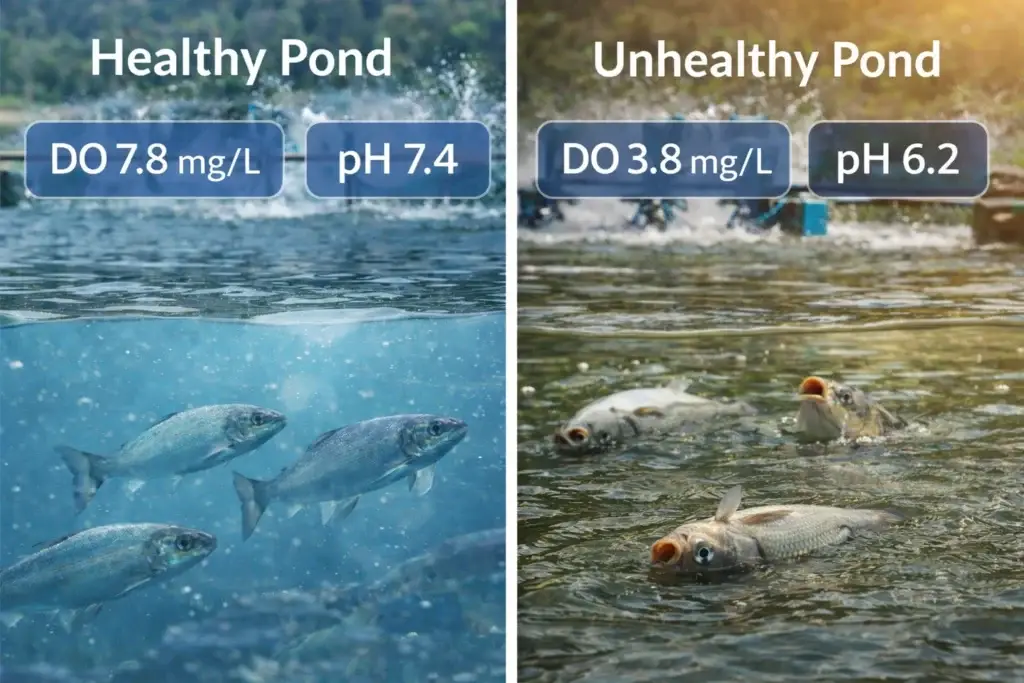
Low dissolved oxygen, pH changes and other water quality issues often occur at the same time — especially in warm conditions or heavily stocked ponds.
👉 Testing ammonia confirms one part of the problem — but additional testing is often needed to fully resolve the issue.
🧪 Recommended Next: Test For underlying problems.
If fish have already died, testing all key parameters is the fastest way to identify the cause and prevent further losses.
👉 The complete kit provides a faster and more reliable solution than testing individual parameters separately.
Shop Aquaculture Water Analysis Test KitIncludes:
- Dissolved Oxygen meter
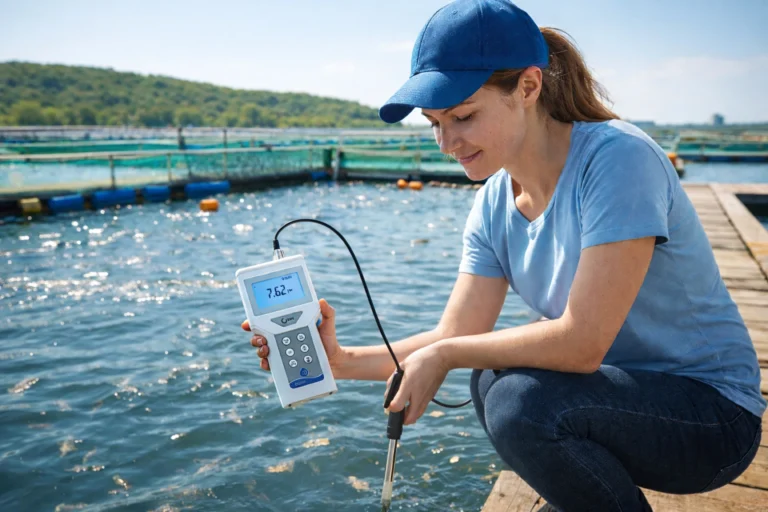
- 5-in-1 meter (pH, EC, salinity, temperature)
- Calibration solutions
👉 Ensures no critical parameter is missed.
If you start with the Ammonia Detox Emergency Treatment and then add the Aquaculture Water Test, you can claim a $40 credit towards the upgrade.
This allows you to:
- act immediately
- confirm the problem
- expand to full monitoring which will probably be needed
👁️ Symptoms to Watch For
Fish often show warning signs before losses occur:
- Gasping at the surface → low oxygen
- Lethargic behaviour → poor water quality
- Red or inflamed gills → ammonia or toxins
- Cloudy eyes → stress or imbalance
- Red streaks in fins → severe stress
👉 These symptoms usually indicate water quality issues, not disease.
⚠️ Other Possible Toxic Conditions
In addition to ammonia, fish may be affected by:
- Nitrite (affects oxygen transport)
- Hydrogen sulfide (from pond sediment)
- Algal toxins (blue-green algae blooms)
- Chlorine or contaminants in water
- Carbon dioxide buildup
👉 These often occur alongside ammonia or low oxygen.
🧪 Individual Instruments (Optional)
If you already have some equipment, you may prefer to test parameters individually:
- Dissolved Oxygen meter
- 5-in-1 water quality meter
- Ammonia test kit
[INSERT BUTTON: Shop Individual Instruments]
👉 However, testing individual parameters may delay identifying the full problem.
🔁 Prevent Future Fish Losses
Regular monitoring is the most effective way to prevent sudden fish deaths.
👉 Test your water routinely:
- Early morning
- After feeding
- During hot weather
- After rain
👉 Healthy water means healthy fish.
Need Help?
If you’re unsure which instrument is right for your pond or aquaculture system, contact Meascom for practical advice on selecting the right solution.
Healthy water means healthy fish.
👉 The instruments below provide the key measurements needed to quickly identify the cause.
| Product | Best for | Most Popular | View All |
|---|---|---|---|
| Dissolved Oxygen Meter | Detecting oxygen crashes before fish losses occur especially before sunrise or during algae-related events. | Shop Most Popular D.O. Meter Kit | View All Dissolved Oxygen Meters |
| pH Meter | Identifying dangerous pH swings that stress or kill fish caused by rainfall, algae activity, or water source change | Shop Most Popular pH Test Kit | View All pH Kits |
| Aquaculture Salt and Brackish Water Test Kit | Routine monitoring of key water quality conditions in sea and estuary applications | Shop Aquaculture Test Kit | View All Aquaculture Test Kits |
| Aquaculture in Fresh, sea and Brackish Water Test Kit | Routine monitoring of key water quality conditions in fresh, sea and estuary applications | Shop Fresh & Salt Water Test Kit | View All Aquaculture Test Kits |
You can also contact us if you need help selecting the most suitable instrument for your pond, tank, or aquaculture system.
Read More…..
Fish and other aquatic organisms depend entirely on the conditions in the surrounding water. When key parameters change too quickly, fish can experience stress, suffocation, or toxic exposure.
Understanding the most common causes of sudden fish deaths helps aquaculture operators identify problems early and take corrective action before serious losses occur.
Fish have evolved to live in 4 distinct and different environments. The water temperature, dissolved oxygen, pH and salinity in there environments are quite different. Knowing these optimal conditions is important for monitoring the health of the aquatic creatures.
Typical Water Quality Conditions for Different Aquaculture Environments
| Environment | Dissolved Oxygen | Temperature | pH | Salinity |
|---|---|---|---|---|
| Marine (Sea Water) | 5 – 8 mg/L | 18 – 26°C | 7.8 – 8.5 | 30 – 35 ppt |
| Brackish Water (Estuaries, Shrimp Ponds) | 4 – 7 mg/L | 22 – 30°C | 7.5 – 8.5 | 10 – 25 ppt |
| Freshwater Coastal / Warmwater Ponds | 4 – 7 mg/L | 20 – 28°C | 6.5 – 8.5 | 0 – 1 ppt |
| Mountain Rivers / Coldwater Systems | 7 – 11 mg/L | 8 – 18°C | 6.5 – 8.0 | 0 ppt |
Why These Ranges Differ
- Cold water holds more oxygen, so mountain rivers naturally have higher dissolved oxygen levels.
- Warm aquaculture ponds have lower oxygen solubility and require aeration.
- Marine systems operate near seawater salinity (~35 ppt).
- Brackish systems occur where freshwater mixes with seawater, such as estuaries and shrimp ponds.
- These ranges vary slightly between species, but they represent typical conditions for healthy aquaculture environments.
1. Dissolved Oxygen Crashes
One of the most common causes of sudden fish deaths is a drop in dissolved oxygen. According to the FAO guidance on dissolved oxygen in aquaculture, low oxygen levels can quickly restrict fish activity and feeding, and prolonged exposure can lead to mortality.
Fish require oxygen dissolved in water in order to breathe. When oxygen levels fall too low, fish may become stressed, gather near the surface, or die if the problem persists.
Dissolved oxygen levels can fall rapidly due to:
• High stocking densities
• Warm water temperatures
• Excess organic waste
• Night-time respiration in algae blooms
• Insufficient aeration
In many ponds the lowest oxygen levels occur just before sunrise, when photosynthesis has stopped overnight but respiration continues.
You can read more about how oxygen behaves in aquaculture systems in our article on dissolved oxygen in aquaculture and aquariums.
2. Sudden pH Changes
Rapid changes in pH can also stress fish and affect their ability to regulate internal chemistry.
Most aquaculture species prefer a pH range roughly between 6.5 and 8.5, although the exact tolerance varies by species.
pH fluctuations may occur due to:
• Heavy rainfall diluting pond water
• Algal blooms affecting photosynthesis cycles
• Excess feed or organic waste
• Changes in water source
Sudden pH swings are often more harmful than a stable pH that is slightly outside the ideal range.
3. Salinity Shock
In marine or brackish aquaculture systems, salinity stability is critical.
Rapid salinity changes can occur when:
• Freshwater enters ponds after heavy rain
• Evaporation concentrates salts
• Water from different sources is mixed
Fish that are adapted to a specific salinity range may struggle to regulate osmotic balance if salinity changes too quickly.
4. Ammonia and Waste Accumulation
Waste from fish metabolism, uneaten feed, and decomposing organic matter can produce ammonia, which is toxic to fish.
Ammonia levels can increase when:
• Feeding rates are too high
• Biological filtration is inadequate
• Water exchange is limited
• Stocking density is excessive
High ammonia levels often coincide with low oxygen conditions, making the situation even more dangerous for fish.
5. Algal Blooms and Night-Time Oxygen Drops
Algae can produce oxygen during daylight through photosynthesis, but they also consume oxygen at night.
In ponds with heavy algal growth, oxygen consumption overnight can exceed oxygen replenishment. This creates a sudden oxygen deficit before dawn.
Fish dying can result from sudden overnight algal blooms which result in rapid oxygen drops in the aquaculture ponds
How to Prevent Fish Dying in Aquaculture Ponds
Most water quality problems can be prevented with routine monitoring and early intervention. Routine monitoring is the most effective way to prevent sudden fish deaths and maintain stable water quality.
| Product | Best for | Most Popular | View All |
|---|---|---|---|
| Dissolved Oxygen Meter | Detecting oxygen crashes before fish losses occur especially before sunrise or during algae-related events. | Shop Most Popular D.O. Meter Kit | View All Dissolved Oxygen Meters |
| pH Meter | Identifying dangerous pH swings that stress or kill fish caused by rainfall, algae activity, or water source change | Shop Most Popular pH Test Kit | View All pH Kits |
| Aquaculture Salt and Brackish Water Test Kit | Routine monitoring of key water quality conditions in sea and estuary applications | Shop Aquaculture Test Kit | View All Aquaculture Test Kits |
| Aquaculture in Fresh, sea and Brackish Water Test Kit | Routine monitoring of key water quality conditions in fresh, sea and estuary applications | Shop Fresh & Salt Water Test Kit | View All Aquaculture Test Kits |
Not sure which instrument is right for your pond or system? Contact Meascom expert for practical advice.
Mobile: +61 439 741 877. Email: ia************@*********om.au
Aquaculture operators should regularly monitor:
• Dissolved oxygen
• pH levels
• Salinity (in marine or brackish systems)
• Temperature
• Signs of waste accumulation
.When fish start dying in aquaculture ponds, the cause is often linked to sudden changes in water quality rather than disease.
Regular testing allows operators to identify trends and correct problems before fish begin to show stress
Using a comprehensive aquaculture water test kit to monitor pH and salinity can help maintain stable water conditions and support healthy fish growth.
Maintaining Healthy Aquaculture Systems
Aquaculture systems are dynamic environments where water quality can change quickly due to biological activity, feeding practices, and environmental conditions.
By monitoring key parameters and maintaining stable water chemistry, aquaculture operators can reduce the risk of sudden fish losses and maintain productive systems.
For reliable monitoring, we recommend starting with a dissolved oxygen meter and a suitable pH or aquaculture test kit.
Here is a 5 in 1 complete kit for monitoring pH and Salnity: easy to use with reliable results.
Here is an excellent Dissolved oxygen meter.
Healthy water means healthy fish.