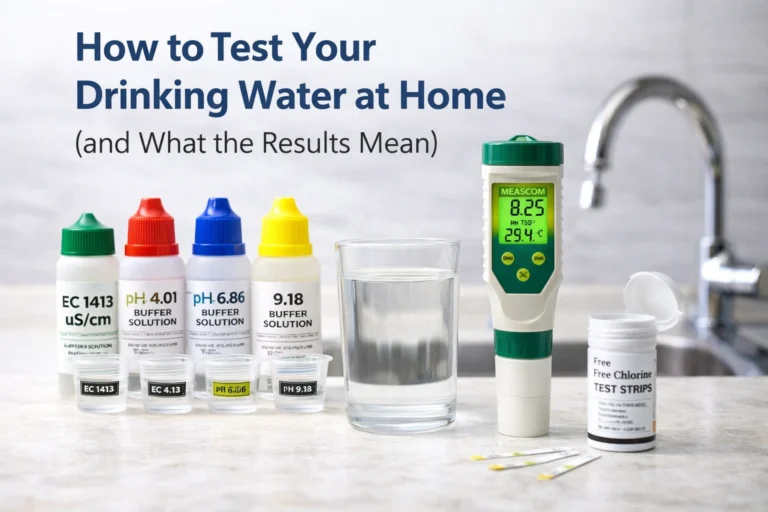
Many pH meter kits include three calibration buffers — typically pH 4, pH 7, and pH 10.
That has led to a common assumption: more buffers must mean better accuracy.
In practice, that’s rarely true.
Accurate calibration depends on choosing the right calibration points for your actual measurement range, not on using every buffer value available.
Calibration accuracy happens between the buffers you use
A pH meter is most accurate between its calibration points.
That means calibration buffers should bracket the pH range you actually measure.
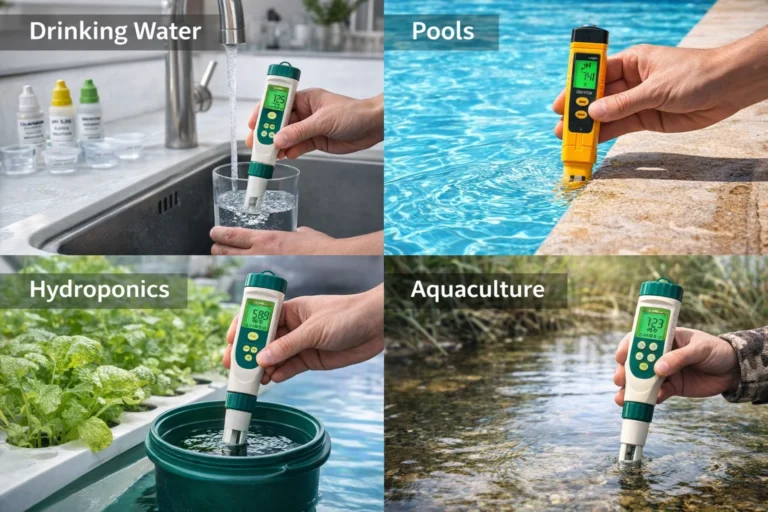
For many real-world applications — water quality, pools, environmental testing, and general field work — measurements sit close to neutral, not at the extremes.
Using extreme calibration points you never measure (such as pH 4 or pH 10) doesn’t improve accuracy where it matters.
Why pH 6.86 is often better than pH 7.00
pH 7.00 is widely known, but pH 6.86 is the internationally recognised neutral reference buffer for many water and environmental applications. Here is why:
- It sits closer to typical real-world samples
- It provides better slope correction in the neutral range
- It is widely used in professional water testing
For many users, 6.86 is a more relevant calibration point than 7.00.
Why pH 9.18 makes more sense than pH 10.00
Similarly, pH 10.00 is rarely encountered in everyday measurements.
Most alkaline water applications fall below pH 9.
Using pH 9.18 instead of pH 10.00:
- Brackets typical alkaline measurements more closely
- Improves accuracy in the range actually measured
- Avoids calibrating far outside real conditions
One buffer, two buffers, or three?
Single-point calibration
Suitable for quick checks near neutral, but limited in accuracy.
Two-point calibration (recommended for most users)
For most applications, two well-chosen buffers deliver better results than three generic ones.
Three-point calibration
Useful when measuring across a wide pH range or for laboratory validation, but unnecessary for many field and water applications.
Choosing buffers by application
| Application | Recommended buffers | Expected pH range |
|---|---|---|
| Drinking water | pH 6.86 + pH 9.18 | 6.5 – 8.5 |
| Pools & spas | pH 6.86 + pH 9.18 | 7.2 – 7.8 |
| Environmental water | pH 6.86 + pH 9.18 | 6 – 9 |
| Hydroponics | pH 6.86 + pH 4.01 | 5.5 – 6.5 |
| Laboratory / wide range | pH 4.01 + 6.86 + 9.18 | 2 – 12 |
Fewer buffers, better practice
Using fewer, more relevant buffers has real advantages:
- Less contamination
- Faster calibration
- Fresher solutions
- Reduced waste
- More consistent results
Accuracy improves not by adding steps, but by removing unnecessary ones.
The Meascom approach
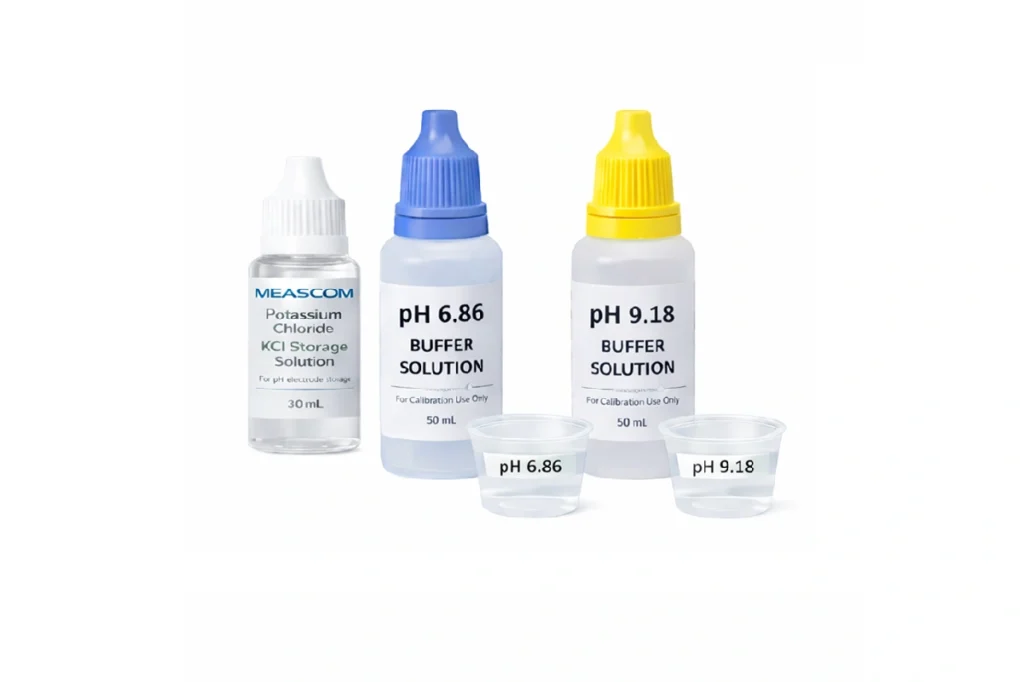
Meascom calibration buffers are:
- Professionally prepared fresh
- Ready to use
- Supplied in practical 50 mL volumes so they are used up before they expire.
- Chosen to match real measurement ranges
- Supplied with labelled plastic cups to hold the buffers during testing and reduce the chance of cross contamination
For most users, two buffers are sufficient — and often preferable.
Key takeaway
You don’t need more buffers.
You need the right buffers.
Meascom produces severaal buffer kits with and without conductivity solution to suit the applications perfectly. Choosing calibration points that reflect what you actually measure delivers better accuracy, less effort, and greater confidence.