Simple pH Experiment for Teaching Acids and Bases in Classrooms
This pH experiment for teaching acids and bases to years 7 to 10 is one of the most important experiments in school chemistry. Students learn how to measure acidity and alkalinity using the pH scale get an understanding of how scientists analyse environmental samples.
A simple classroom experiment using a pH tester allows students to see the pH scale in action while learning how scientific instruments are calibrated and used.
Teaching the pH Scale in the Australian Science Curriculum
The pH scale and acids and bases are part of the Australian Science Curriculum taught in middle and secondary school science.
Students learn about:
• acids and bases
• chemical properties of substances
• environmental chemistry
• scientific measurement and calibration
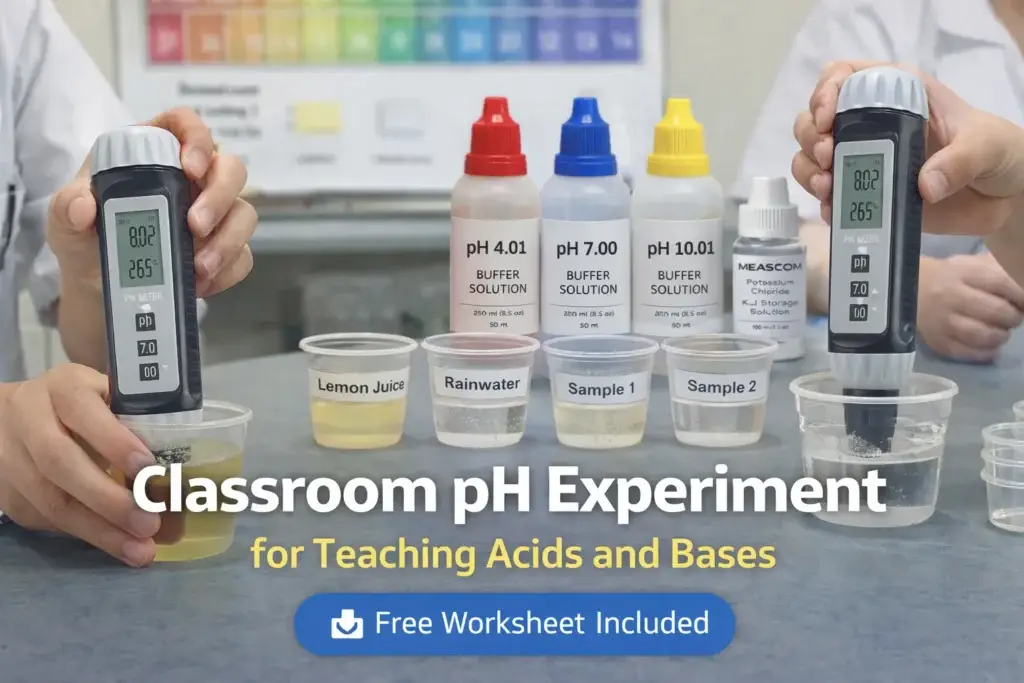
Practical classroom experiments help students understand these concepts by measuring the pH of real substances such as rainwater, lemon juice and household solutions.
Hands-on activities like this classroom pH experiment help reinforce the scientific method and allow students to record and interpret real data.
Free Classroom Worksheets for This Experiment
Teachers can download the printable worksheets used in this classroom pH experiment.
Included resources:
• pH experiment worksheet
• pH meter calibration worksheet
• environmental water testing worksheet
• teacher instruction sheet
👉 Access the Free Classroom Worksheets
👉You can see the full Meascom Classroom pH Experiment Kit here:
What is the pH Scale?
The pH scale measures how acidic or alkaline a liquid is.
| pH Range | Description |
|---|---|
| 0–3 | Strong acid |
| 4–6 | Weak acid |
| 7 | Neutral |
| 8–10 | Weak base |
| 11–14 | Strong base |
The pH scale is logarithmic, meaning each step represents a ten-fold change in acidity.
This means a solution with pH 3 is ten times more acidic than a solution with pH 4.
A Simple Classroom Experiment
Students can investigate the pH of common substances found in everyday life.
Typical samples include:
• Lemon juice
• Rainwater
• Baking powder solution
• Soap solution
Students measure the pH of each sample and record their results on the pH scale.
Step 1 – Calibrate the pH Tester
Before measuring samples, scientists check that their instruments are accurate.
Students calibrate the pH tester using standard buffer solutions:
• pH 4.01
• pH 7.00
• pH 10.01
These calibration buffers ensure the readings are correct.
Step 2 – Measure the Samples
Students gently place the probe into each liquid and record the pH reading.
Between samples the probe is rinsed to avoid contamination.
Step 3 – Record and Analyse Results
Students record their measurements and compare the acidity of different substances.
Typical results are:
| Substance | Typical pH |
|---|---|
| Lemon juice | 2–3 |
| Rainwater | 5–6 |
| Baking powder solution | 7–8 |
| Soap solution | 8–9 |
This helps students understand how the pH scale relates to everyday substances.
Why Calibration Matters
Scientific instruments must be calibrated to ensure accurate results.
Using buffer solutions allows students to see how scientists maintain measurement accuracy in real laboratories.
Classroom pH Experiment Kit
To make the experiment easy to run in schools, the Meascom Classroom pH Experiment Kit includes everything needed for a full class experiment.
The kit supports six student groups and includes:
• 6 pH testers
• replacement electrodes
• NIST calibration buffers
• KCl storage solution
• calibration cups
• teacher instructions and worksheets
This allows an entire class to perform the experiment simultaneously.
Free Classroom Worksheets for This Experiment
Teachers can download the printable worksheets used in this classroom pH experiment.
Included resources:
• pH experiment worksheet
• pH meter calibration worksheet
• environmental water testing worksheet
• teacher instruction sheet
 Access the Free Classroom Worksheets
Learn More
You can see the full Meascom Classroom pH Experiment Kit here:
This experiment is suitable for Year 7–10 science classes studying acids, bases and environmental chemistry.
Students can also learn more about pH of fizzy drinks from the Royal Society of Chemistry